Microscopy Resolution & Nyquist Calculator: optimal pixel size from NA & wavelength
Are your pixels small enough?
Diffraction sets how fine your microscope can resolve — and to actually capture that detail your camera pixels have to be small enough (the Nyquist criterion). This tool turns NA, wavelength, and immersion medium into the resolution and the pixel size you need, then tells you whether your camera + objective are under- or over-sampling.
Use it now
Found a bug or want a feature? Tell us — we read everything.
What it does
- Lateral resolution — Rayleigh (
0.61·λ/NA) and Abbe (λ/2·NA). - Axial resolution — widefield (
2·λ·n/NA²). - Nyquist pixel size — the object-space sampling you need (
Rayleigh/2.3; Nyquist minimum isRayleigh/2), plus the required camera pixel at the sensor (× magnification). - Sampling verdict — enter your camera pixel size + magnification and it flags well-sampled / Nyquist-minimum / undersampled.
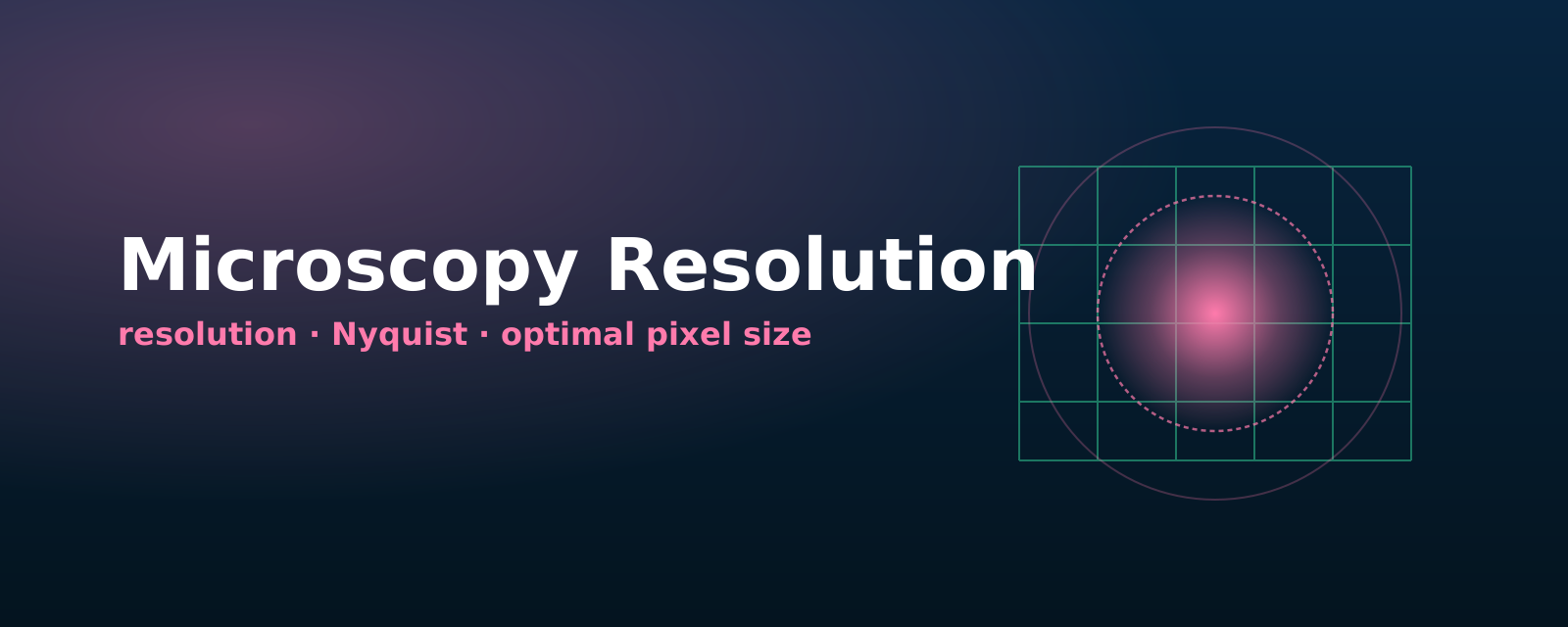
- Live Airy-disk visualization — the diffraction spot drawn over your sampling grid, color-coded by the verdict, so you can see whether the pixels resolve the disk (aim for ≥ 2–3 pixels across the radius).
A worked example
NA 1.4, 520 nm emission, oil (n 1.515), 60× → lateral resolution ≈ 227 nm (Rayleigh), axial ≈ 804 nm, recommended pixel ≈ 99 nm in object space, so you want a sensor pixel ≤ ~5.9 µm. A 6.5 µm camera at 60× gives ~108 nm pixels — right at the Nyquist edge.
Estimates are widefield and diffraction-limited. Confocal and super-resolution modalities use different relationships (e.g. confocal axial ≈ 1.4·λ·n/NA²) — treat these as the standard widefield baseline.
Embed it on your site
<link rel="stylesheet" href="https://www.37degrees.io/interactive-tools/microscopy-resolution/styles.css" />

<div id="microscopy-widget-embed"></div>

<script>
  // Optional: window.MICROSCOPY_THEME = "light";
</script>
<script src="https://www.37degrees.io/interactive-tools/microscopy-resolution/widget.js"></script>
Credits
Built and maintained by 37degrees. Standard diffraction/Nyquist relationships — no third-party libraries, no data leaves the browser.