Real-time cell culture telemetry: from "did it crash overnight?" to "what happened at 02:14 am?"
Every cell biologist knows the morning ritual. You open the incubator at 8:47 am and the display reads 37.0 °C / 5.00 % CO₂. The cells look fine. You exhale.
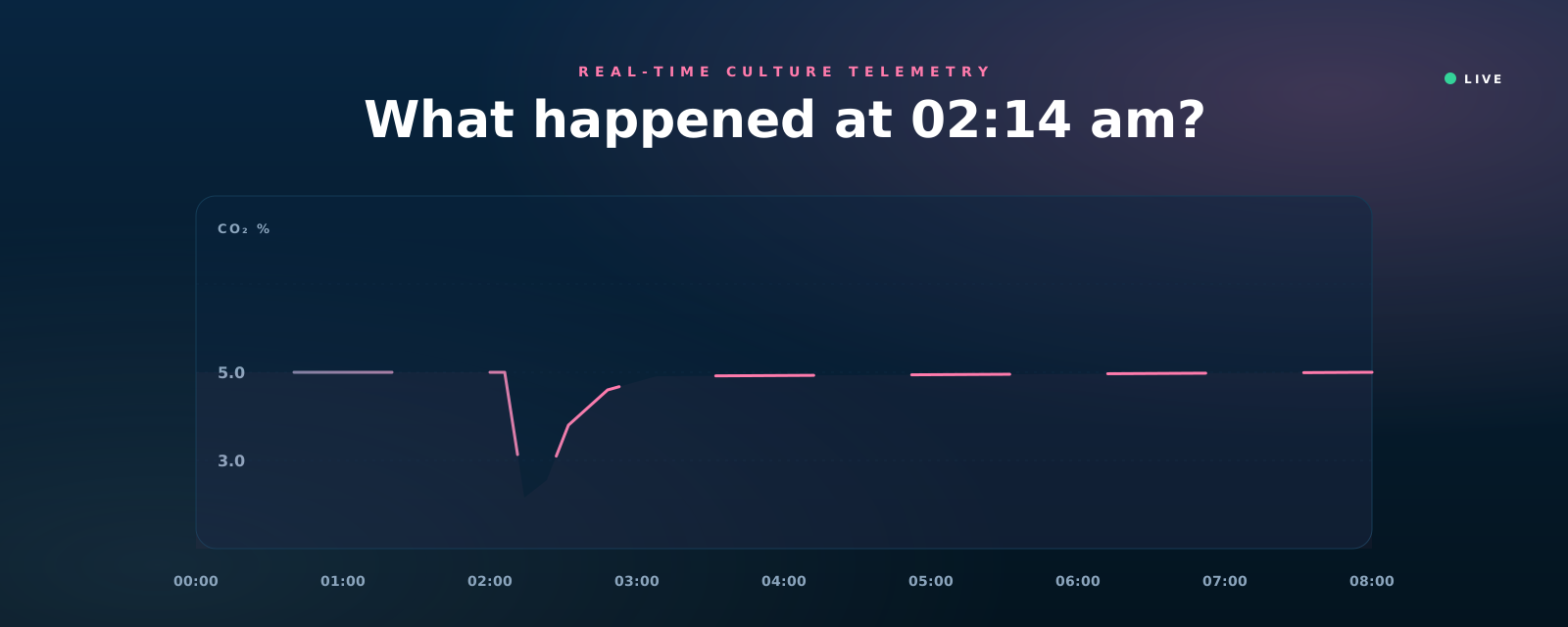
But what happened at 02:14 am?
A traditional CO₂ incubator gives you a single data point: the value it is showing right now. It does not tell you whether the door was opened by the late-night PhD student at midnight. It does not tell you that the CO₂ regulator drifted for forty minutes and corrected itself before you came in. It does not tell you that the HVAC kicked in a thermal spike at 04:30 am — long enough for stress-sensitive iPSCs to register it, short enough to leave no visible mark by morning.
The “did everything stay normal?” question is the one that matters. And for the last fifty years, the only honest answer has been: I don’t know.
The blackbox problem
A shared incubator is a blackbox not because it lacks sensors — it has them — but because the sensor data does not go anywhere. The set-point gauges show you “now,” and “now” is the only thing you can verify.
What gets lost:
- Door-opening events — how many times, by whom, for how long, with what recovery latency.
- Regulator drift — long-term creep in CO₂ or humidity, just inside the alarm threshold.
- Brief thermal excursions — short enough that the system recovered before the display moved; long enough to perturb the culture.
- Power and HVAC anomalies — building-level events that affect every incubator in the room.
- Cross-incubator correlation — when five units in a shared room drift in lockstep, it is almost always an environmental cause and never a single-unit fault.
If any of these contributed to your experimental outcome, you will never know. You will attribute the result to biology and design the next experiment from a faulty baseline. (We covered the underlying contamination and stress economics in The hidden variable: how shared cell culture incubators are compromising your biological data — this article is about what telemetry adds on top of dedicated, per-experiment incubation.)
What “real-time” actually means
“Real-time” in lab equipment usually means “the display updates every second” — not “the history is captured at second-by-second resolution and available to query.” Those are different things, and the second one is what changes how you work.
True streaming telemetry has five properties:
- Continuous capture, not snapshots. Each channel sampled at the frequency it deserves — ~10 s for the incubator basics (temperature, CO₂, humidity), enough to surface every meaningful change without flooding storage, and down to ~1 s for fast-moving signals like door state, regulator pulse, and on-board fault codes.
- Edge buffering. A network blip does not lose a minute of data; the device holds and replays the buffer when the link returns.
- Time-aligned ingest. Streams from multiple devices share a common clock so cross-unit correlation is meaningful.
- Queryable history. Not just a chart — you can ask “show me every door event in the last 30 days where CO₂ recovery took longer than 8 minutes,” and get an answer.
- Per-experiment alerting. Configurable to the protocol that is actually running, not a single global threshold everyone ignores.
This is what the OMĒOS data layer does for every CultureON 100 unit in the field — and it is the difference between a chart on a screen and a record you can build experiments on.
What you can see now that you couldn’t before
The 02:14 am door event
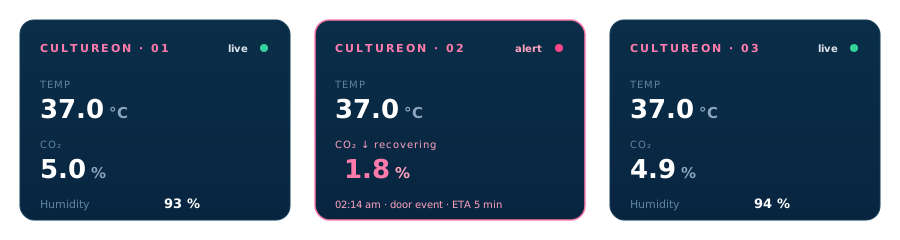
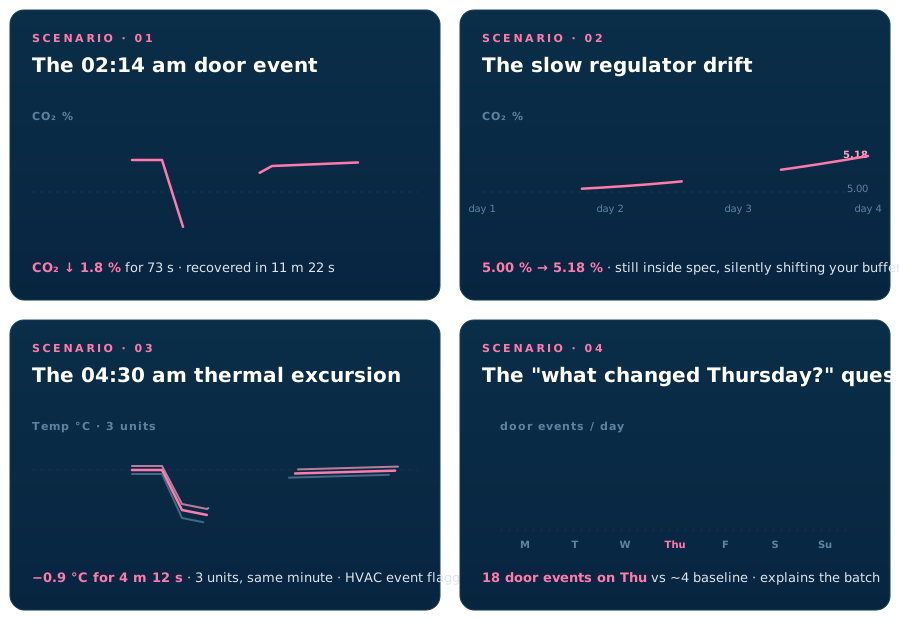
A door-opening signal at 02:14 am is not an alarm — it is a fact, recorded with the recovery curve attached. The night-shift student opened the unit for 73 seconds. CO₂ dropped to 1.8 % before the seal closed. Full re-equilibration took 11 minutes 22 seconds. Your culture saw nine minutes outside the 4.5–5.5 % band.
Now: when your Friday confluence reading is 12 % below expectation, you have a candidate explanation. You can correct for it, exclude that well, or — if it is clearly outside the operating envelope — invalidate the run and document why. The point is not that you catch every event; the point is that nothing is invisible anymore.
The slow regulator drift
A CO₂ regulator that creeps from 5.00 % → 5.18 % over four days is not an alarm; it is well inside spec. But it is also a 4 % relative shift in your buffering, sustained across an entire experiment.
With streaming telemetry, that trend shows up as a slope rather than a value. You see it before it matters and recalibrate. Without it, your “well-controlled” experiment is silently drifting under the floor of any control chart you would have run on a single morning measurement.
The thermal excursion that “never happened”
The HVAC kicks at 04:30 am. Three incubators in the room register a 0.9 °C dip lasting 4 minutes 12 seconds, then full recovery. By morning, every display reads 37.0 °C. Nothing in the steady-state record shows anything happened.
If you are running stress-sensitive cells — primary cultures, iPSCs, organoid expansion — you needed to know. With cross-incubator correlation, the system flags this as an environmental event and timestamps it on every affected experiment automatically.
Real-time telemetry is not about more numbers on a dashboard. It is about turning the most consequential variable in your experiment from a blackbox into a queryable record.
The “what changed last Thursday?” question
The deepest value is not catching events as they happen. It is being able to answer the question every PI eventually asks: what was different about the Thursday batch? When the answer is “the CO₂ recovery time was 40 % longer than baseline because the door was opened 18 times instead of the usual 4,” you have a real explanation. Without that record, you have a guess.
Where minutes actually matter
Some real-time signals are about historical accountability. Some are about live intervention. The latter is where the value compounds:
- Active perfusion runs. A flow anomaly during a 72-hour perfusion is a recoverable event if you catch it at minute 3 — and an experiment loss at hour 30.
- Differentiation protocols. Hour-windowed cytokine pulses depend on the incubator being inside spec at the right minute. A live alert lets you abort and restart at a known state instead of pushing through.
- Long imaging runs. A two-hour drift while you are at lunch can ruin an overnight time-lapse. Catching it at minute 15 lets you intervene before the run is wasted.
- Stress-sensitive expansions. iPSC and organoid lines that take weeks to recover can be saved by a 30-second SMS that says “Unit 02 dropped below 4.5 % CO₂ — investigating.”
For these workflows, real-time is not a nice-to-have. It is the difference between a usable result and a discarded one — and frequently the difference between a published figure and another month of re-running.
What it changes in the experimental record
There is a deeper shift than alerts. When telemetry is captured continuously, your experiment is no longer a notebook entry that assumes steady state. It becomes a queryable record of:
- Every environmental parameter at the resolution the equipment can measure.
- Every event — door, alarm, recovery — with its timestamp and recovery curve.
- Every cross-device correlation the system flagged during the run.
This is what reproducibility means in the modern sense. Not “I followed the protocol” but “here is the time-aligned trace of what the cells actually saw.” When a reviewer asks why the control well behaved unexpectedly on day 6, you have an answer. When you re-run the experiment a year later, you start from data instead of from memory.
It also changes what you can teach. New trainees no longer rely on senior-lab folklore to recognize a problem; they can scrub the timeline of a finished experiment, see exactly when something drifted, and learn the patterns that take ten years to build by intuition alone.
CultureON 100 + OMĒOS in practice
Every CultureON 100 ships as a streaming device. Temperature, CO₂, humidity, door state, regulator activity, and on-board fault codes flow continuously to the OMĒOS data layer over Wi-Fi or Ethernet. From there:
- The live dashboard shows current state across every unit you operate — your bench, the next bench, a collaborator’s lab across the building.
- Event detection runs on the ingest path. Door events, threshold crossings, and recovery anomalies are surfaced immediately — by push, SMS, or email — with the recovery curve attached so you do not have to chase it.
- Cross-device correlation flags environmental events that affect multiple units — the “04:30 am HVAC event” case — and annotates them on every affected experiment automatically.
- Every experiment record is linked to the device traces that ran on it. The “what happened at 02:14 am?” query becomes a one-click answer six months later.
Because the data is captured at instrument-grade resolution and never aggregated away, you can come back later and still ask high-fidelity questions about a finished experiment. The protocol is in the notebook; the evidence is in the stream.
The reason this works is that the hardware and the software were built together, not bolted onto each other. CultureON 100 was engineered from the first prototype to emit a continuous stream. OMĒOS was built to do something useful with those streams — not just display them. That is what separates a real-time-by-design platform from a smart-incubator add-on.
From “did it crash overnight?” to a record you can defend
The morning ritual will not disappear — opening the incubator and checking on the cells is part of the craft. But the question behind it changes. You are no longer asking is everything OK right now? because you already know. You are asking what did I miss while I wasn’t here? — and now you have an answer.
That is the shift. Real-time cell culture telemetry is not a feature on top of an incubator. It is a different relationship between the experimenter and the experiment: continuous instead of episodic, queryable instead of remembered, defensible instead of trusted.
Stop guessing what happened at 02:14 am. Start knowing.
Ready to see your cells in real time? Explore CultureON 100, the portable CO₂ incubator that streams every parameter to OMĒOS by default — or request more information about deploying a fleet across your lab.