When light kills cell culture experiments — and how to avoid it
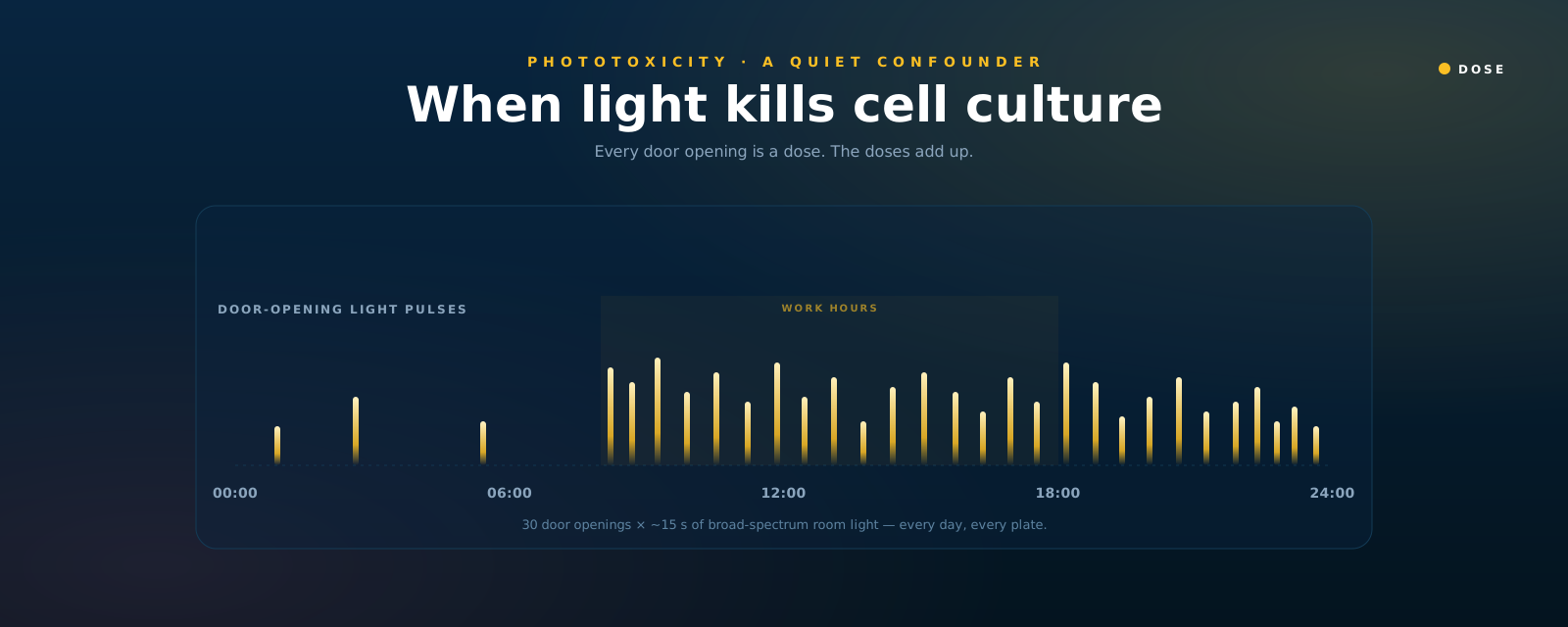
The shared-incubator door swings open. Fluorescent ceiling tubes and laptop screens flood the chamber for ten, twenty, thirty seconds at a stretch. Then it shuts and nobody thinks about it again.
What just happened to the cells inside is not nothing.
Light is a reagent
Cell-culture media is engineered around the assumption that it stays in the dark. Two of its most common ingredients — riboflavin (vitamin B₂) and HEPES buffer — are photoactive. Under broad-spectrum visible and UV-A light, they generate reactive oxygen species (ROS): hydrogen peroxide, superoxide, singlet oxygen.
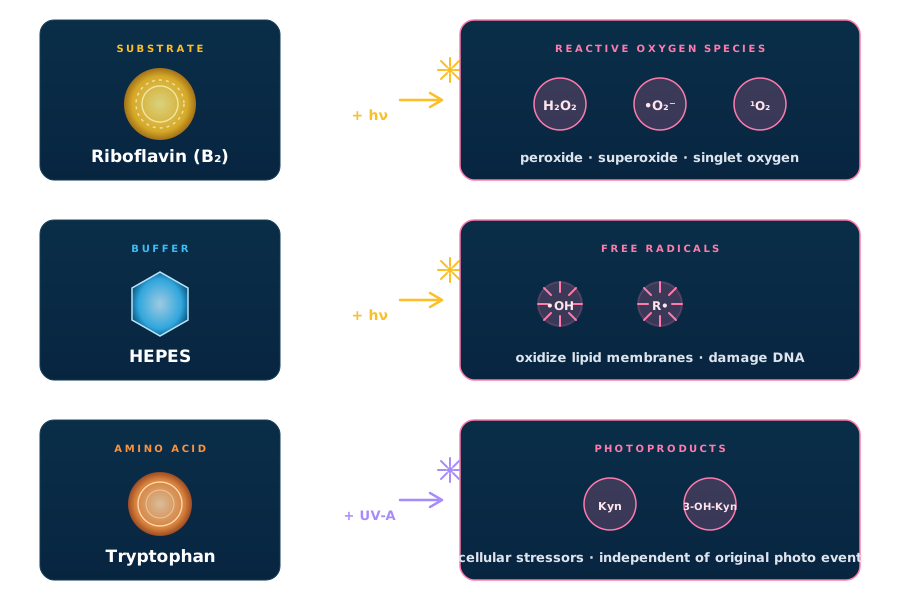
- Riboflavin + light → H₂O₂. A 2014 study (Grzelak et al.) measured peroxide accumulation in DMEM exposed to standard cool-white fluorescent light at concentrations sufficient to kill HeLa cells within hours of continued exposure.
- HEPES + light → free radicals. HEPES, present in nearly every modern formulation, photodegrades into radicals that oxidize membrane lipids and damage DNA.
- Tryptophan + UV-A → kynurenines. These breakdown products themselves act as cellular stressors, independent of the original photo event.
The dose accumulates. A shared incubator opened thirty times a day for fifteen seconds receives seven and a half minutes of room light per day — every day, on every flask, on every plate.
Which wavelengths actually matter
Not every wavelength of room light is equally dangerous. The photochemistry above is driven by specific bands:
- UV-A (320–400 nm). The most damaging — UV-A photons carry enough energy to drive tryptophan and flavin photodegradation directly. Modern fluorescent tubes and many “white” LED panels still emit a measurable UV-A tail, even when the light looks visually pure.
- Visible blue (400–500 nm). Strongly absorbed by riboflavin (peak absorption near 445 nm) and by the FMN/FAD cofactors in any flavoprotein in solution. LED panels with the typical “cool white” or “daylight” spectrum are blue-heavy, and they drive flavin chemistry efficiently.
- Visible green and red (500–700 nm). Less directly photochemical, but contribute lower-yield ROS generation in the presence of phenol red, fluorescent reporters, or any other dye-class species in your media.
The takeaway: the lighting choice in your room is not a fix. Cool-white fluorescents and cold-white LEDs both drive these reactions, just with somewhat different spectra. The only durable mitigation is keeping the chamber dark between the moments you are actually looking at the cells.
What the literature actually shows
The literature on cell-culture phototoxicity goes back five decades, but it gets cited surprisingly rarely in methods sections.
Stoien & Wang (1974, PNAS) were among the first to document systematically that fluorescent-room exposure killed mammalian cells in culture — an effect they traced to media constituents, not to the cells themselves.
Wang & Nixon (1978) then identified riboflavin as the principal photosensitizer responsible for the toxicity. Removing riboflavin from the media (or shielding it from light) eliminated most of the effect in their assays.
Zigler et al. (1985) demonstrated specifically that HEPES-buffered media exposed to laboratory light became cytotoxic, and that the effect scaled with HEPES concentration. This is significant because HEPES is in nearly every modern formulation.
Edwards et al. (1994) quantified peroxide generation in DMEM under cool-white fluorescent light and showed it was sufficient to drive lymphocyte apoptosis within hours of exposure.
Grzelak et al. (2001, Free Radical Biology and Medicine) extended the quantification: a few hours of standard fluorescent exposure produced hydrogen peroxide at concentrations in the hundreds of micromolar range — well above the threshold for oxidative-stress responses in most mammalian cells.
These are not obscure findings — they are textbook material in cell biology curricula. The reason they rarely surface in methods sections is structural: the experiment-by-experiment effect is small (10–20 % growth slowdown, elevated CV), so it rarely registers as a discrete failure. It registers as noise — and noise is what we tend to attribute to the cells.
What this does to your data
Phototoxic stress doesn’t always announce itself as cell death. More often it shows up as:
- Elevated baseline ROS — confounding any oxidative-stress assay you were trying to run.
- Altered gene expression — heat-shock and antioxidant-response genes upregulated before the experiment even begins.
- Reduced proliferation rates — a 10–20% slowdown that gets blamed on serum lots, passage number, or “Tuesday cultures.”
- Photosensitizer artifacts — if you use phenol red, fura-2, fluorescent reporters, or any GFP variant, you have additional photoactive species accumulating damage with every door opening.
The cruelty of it is that none of this appears in the controls — both the experimental and control flasks share the same light exposure, so the noise sits underneath every condition equally. You don’t see a confounder; you see a higher coefficient of variation and a result that won’t replicate cleanly in another lab.
Why decontamination cycles aren’t the answer
The standard mitigation — “open the door less, work faster” — collides directly with how shared incubators actually get used. Three to six researchers per unit, each running their own cadence, means the light exposure is governed by the noisiest neighbor, not by you.
Wrapping flasks in foil helps for non-imaged cultures but creates its own thermal microenvironment and is incompatible with any optical inspection. Amber-bottle media slows photodegradation in the fridge, not inside the incubator. The variable is the incubator chamber itself, and the only durable fix is to take light out of it.
How much light does a personal incubator actually remove?
The math behind the 95 % reduction is straightforward.
A shared incubator opened 30 times a day for ~15 seconds receives 7 minutes 30 seconds of broad-spectrum room light per day. Across a 30-day experiment, that accumulates to roughly 3 hours 45 minutes of light dose — without anyone noticing, because no single opening seems consequential.
A personal incubator at your bench is opened only when you actually need to handle your cultures — typically four times a day, briefly. That works out to about 30 seconds of light per day. Over the same 30-day window, total exposure is under 15 minutes — a ~95 % reduction in cumulative dose, without changing anything about the cells, media, or protocol.
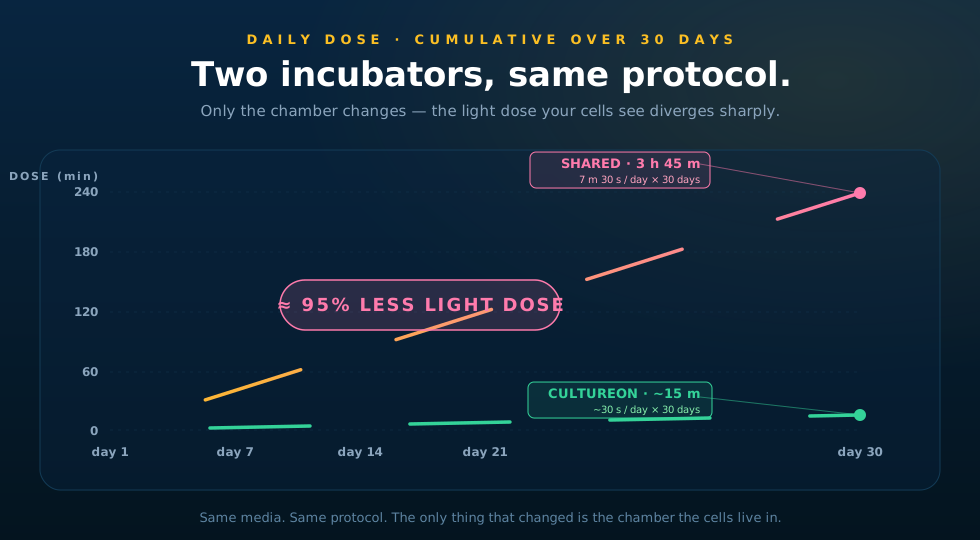
The cells in a personal incubator are not just exposed less often — they are exposed less, per day, per week, and per project. The dose reduction is the entire point.
How CultureON 100 eliminates the variable
CultureON 100 is a personal, light-sealed CO₂ incubator that sits at your bench. Two things change the moment you move your cultures into one:
1. The chamber stays dark. The interior is fully enclosed and opaque — no glass inner door, no observation window. Cells live in genuine darkness between handling steps, exactly the way the media chemistry assumes.
2. The door opens on your schedule, not the lab’s. Because the unit is dedicated to your work, the only door openings are yours. For most workflows that is two to four per day, not twenty to fifty — an order-of-magnitude reduction in light dose before any other change.
Combine those and the cumulative phototoxic load on a typical experiment drops by ~95 % versus shared-incubator baseline, restoring media chemistry to its intended dark state and pulling a hidden source of experimental noise out of every assay you run.
What this means practically — and for reproducibility
Phototoxic confounding is exactly the kind of hidden variable that makes results irreproducible across labs. Each lab has different room lighting, different door cadence, different incubator placement relative to the overhead tubes. None of that gets captured in a methods section — but all of it ends up in the data.
If you have ever blamed a serum lot, a freezer cycle, or a “bad week” for an unexpectedly high standard error, light dose is on the list of things worth ruling out. The cleanest test is the simplest one: run the same experiment in a shared incubator and a CultureON 100 in parallel for two weeks, and compare CVs on whichever readout you trust most.
Most labs that do this stop running the comparison after the first round.
Keep reading
Light is one hidden variable. There are others. For the broader contamination, stress-cycle, and budget case against the shared incubator — and the dollar math on a single fungal outbreak — read our companion piece, The hidden variable: how shared cell culture incubators are compromising your biological data (and your budget). The two articles cover the same problem from different angles, and the case is stronger when you read them together.
Further reading
- Grzelak A. et al., Light-dependent generation of reactive oxygen species in cell culture media, Free Radical Biology and Medicine, 2014.
- Zigler J.S. et al., Analysis of the cytotoxic effects of light-exposed HEPES-containing culture medium, In Vitro Cellular & Developmental Biology, 1985.
- Stoien J.D., Wang R.J., Effect of near-ultraviolet and visible light on mammalian cells in culture, PNAS, 1974.