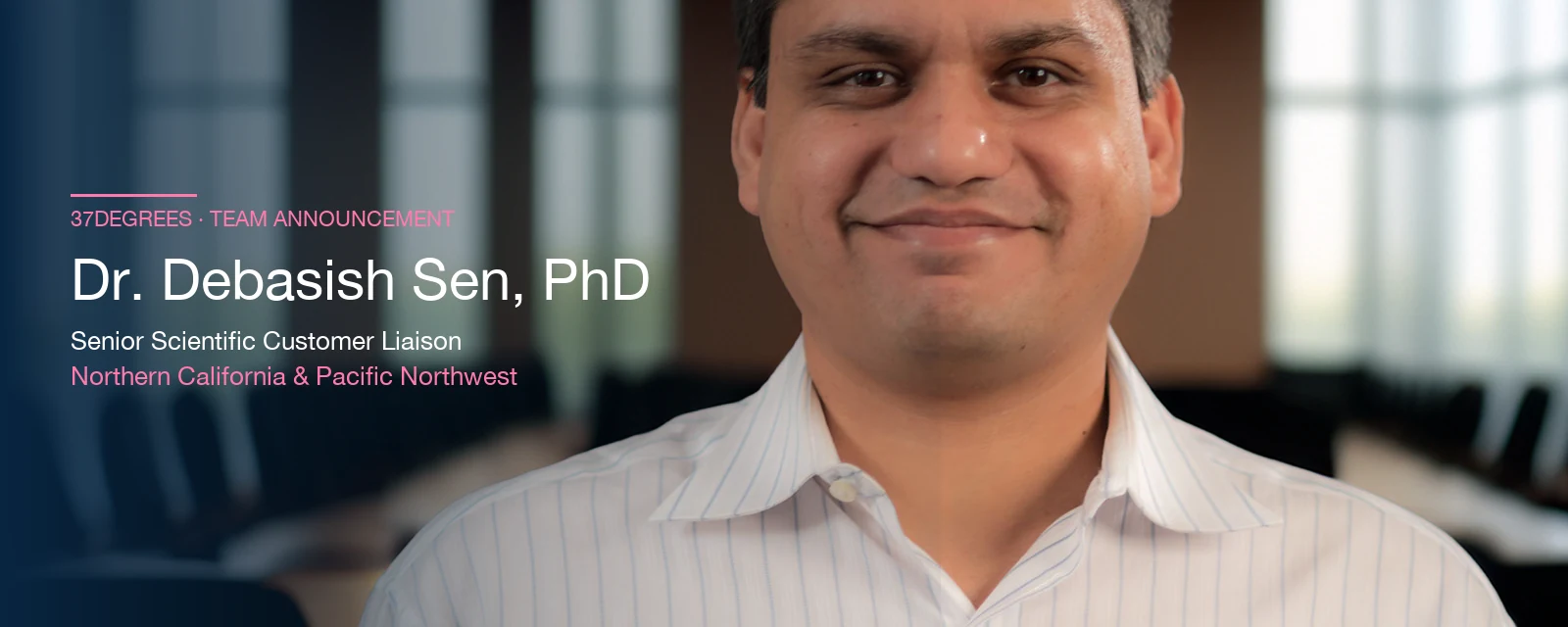
37degrees, Inc. is pleased to announce the appointment of Dr. Debasish Sen, PhD as Senior Scientific Customer Liaison covering Northern California and the Pacific Northwest. Dr. Sen is based in San Francisco.
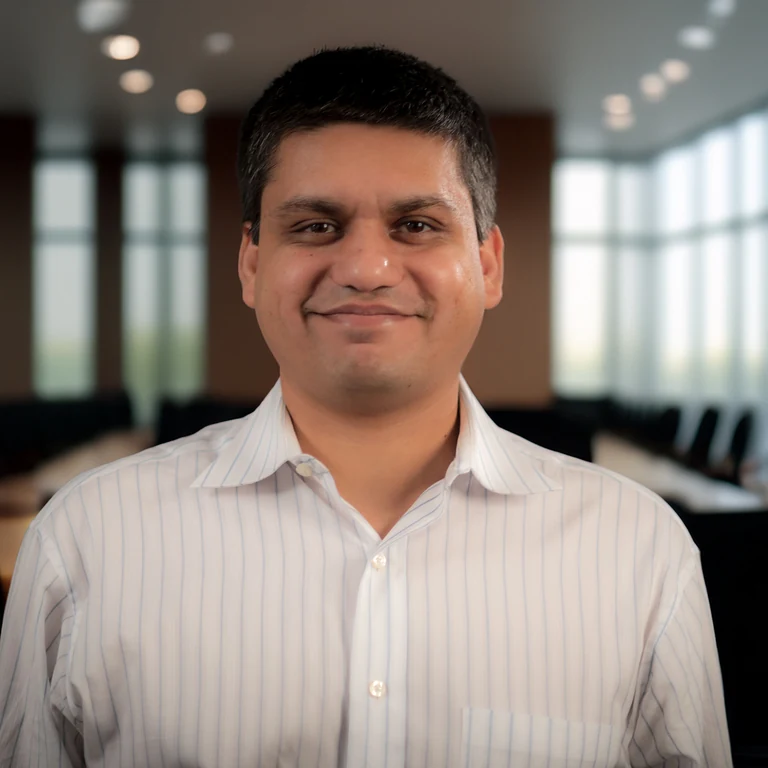
In this role, Dr. Sen serves as the primary scientific point of contact for principal investigators, research scientists, and laboratory teams across Northern California — including the San Francisco Bay Area, Sacramento Valley, and Monterey Bay region — and the Pacific Northwest, who are evaluating or deploying 37degrees instruments and the OMĒOS data platform. The position is structured around scientific engagement — giving research groups direct access to a senior peer scientist as they integrate 37degrees technology into their experimental workflows.
Scientific background
Dr. Sen is an immunologist with more than two decades of research and translational drug-discovery experience spanning academia, pharma, and biotech.
- B.Tech. (Honours), Computer Science and Engineering — Indian Institute of Technology, Kharagpur (2002).
- PhD, Biological Sciences — University of California, Irvine (2009). Doctoral work in the Cahalan laboratory focused on two-photon intravital imaging of dendritic-cell trafficking and innate immune dynamics.
- Postdoctoral training — University of California, San Francisco (Pathology) in the Krummel laboratory (2010–2014), with research on the role of myeloid cell differentiation and T cells in lung immunology.
- Postdoctoral training — Stanford University (Structural Biology) (2014–2016), developing high-resolution optical coherence tomography (OCT) and contrast-enhanced in vivo imaging methods.
Dr. Sen subsequently held senior research positions at Asterias Biotherapeutics, Pfizer (Oncology R&D), TEVA Pharmaceuticals (Specialty Biologics R&D), and 23andMe (Therapeutics R&D) — leading translational immunology and immuno-oncology programs from target validation through IND-enabling studies.
Selected publications
Dr. Sen’s research has been published in Nature Communications, PNAS, Journal of Experimental Medicine, Cancer Research, Mucosal Immunology, Journal of Immunology, Scientific Reports, Journal of Biomedical Optics, and PLOS One, among others. The following are representative of the live-cell imaging and intravital work most directly relevant to 37degrees customers:
- Sen D, Jones SM, Oswald EM, Pinkard H, Corbin K, Krummel MF. Spatio-temporal monocyte to macrophage differentiation in inflamed lungs. PLOS One. 2016;11(10):e0165064. [PubMed →]
- Thornton EE, Looney MR, Bose O, Sen D, et al. Spatially organized dynamics of antigen uptake by lung dendritic cells. Journal of Experimental Medicine. 2012;209(6):1183–1199. [PubMed →]
- Sen D, Forrest L, Kepler TB, Parker I, Cahalan MD. Selective and site-specific mobilization of dermal dendritic cells and Langerhans cells by Th1- and Th2-polarizing adjuvants. PNAS. 2010;107(18):8334–8339. [PubMed →]
- Liba O, SoRelle ED, Dutta R, Sen D, et al. Speckle-modulating optical coherence tomography in living mice and humans. Nature Communications. 2017;8:15845. [PubMed →]
Dr. Sen is also named on issued and pending United States patents covering MHC-restricted telomerase peptide therapeutics and anti-PD-1 / IL-2 immunoconjugates, including US Patent 12,281,148 (granted 2025) and US Patent Application 2023/0134801 (published 2023).
Areas of scientific expertise
Dr. Sen’s technical depth spans the methodologies most directly relevant to live-cell research and the kind of work 37degrees customers run every day:
- Long-term and intravital fluorescence imaging — two-photon microscopy, confocal and immunofluorescence microscopy, and multi-day live-cell time-lapse acquisition.
- High-throughput and high-content imaging for primary-cell, organoid, and immunology assay workflows.
- Optical coherence tomography (OCT) — including contrast-enhanced and molecular OCT modalities for in vivo imaging.
- Flow cytometry and single-cell phenotyping in immunological and immuno-oncology contexts.
- Translational drug discovery — target validation, mechanism-of-action studies, preclinical in vivo pharmacology, and IND-enabling package design.
- Machine-learning pipelines for cellular image analysis, including model development for quantitative phenotypic readouts.
Scientific support for West Coast research groups
Dr. Sen’s role is structured to give research groups in Northern California and the Pacific Northwest a direct line to a senior scientist for the questions that matter when bringing connected instrumentation into a working laboratory.
That scope of support includes:
- Experimental-design consultation on the use of current 37degrees instruments — including CultureON 100 and the OMĒOS data platform — across a range of life-science and translational research contexts, with engagement on adjacent biological workflows as the 37degrees instrument platform expands.
- Methodological guidance on experimental modality selection, contamination and environmental control during multi-day acquisitions, and the data-integrity practices that downstream reviewers, regulators, and reproducibility audits expect.
- Technical interpretation of instrument output and OMĒOS-streamed datasets, including integration with downstream analysis pipelines.
- A scientific feedback channel back to the 37degrees engineering and research teams, so that what is learned in customer laboratories informs the next generation of 37degrees instruments — across both current and emerging biological application areas — and the open-source cellular image-analysis stack we maintain in collaboration with the broader community.
Together, Northern California and the Pacific Northwest host two of the most active concentrations of life-science research in the United States — UCSF, Stanford, the Gladstone Institutes, the Chan Zuckerberg Biohub, UC Berkeley, and the Bay Area biotech corridor in the south; the Fred Hutchinson Cancer Center and University of Washington Medicine in Seattle and OHSU’s Knight Cancer Institute in Portland to the north — spanning immuno-oncology, structural biology, developmental biology, and translational drug discovery. Dr. Sen will be working directly with research groups in these and adjacent institutions.
Mentorship and STEM education
Beyond his professional research, Dr. Sen is actively engaged in mathematics education and mentorship of the next generation of scientists. He works with EnCorps — a nonprofit that places practicing STEM professionals into math and science classrooms in under-resourced schools — and with the Art of Problem Solving community, which serves advanced mathematics students preparing for competitions and rigorous undergraduate science programs. He also mentors PhD scientists in their early-career transitions.
Dr. Sen views strong mathematical foundations as essential to modern life-science research, given how quantitative and data-driven contemporary biology has become — a perspective that aligns directly with 37degrees’ work in connected instrumentation, streaming experimental data, and machine-learning-enabled image analysis.
Contact
Research groups in California, Washington, Oregon, Idaho, and the broader West Coast who would like to engage Dr. Sen for a scientific conversation about live-cell experimental design, long-term imaging, or the integration of 37degrees instrumentation into their workflows are encouraged to get in touch.
- Contact 37degrees → — messages route directly to our team and are triaged within one business day.
37degrees welcomes Dr. Sen to the team and looks forward to the scientific partnerships this appointment will enable across Northern California, the Pacific Northwest, and the broader West Coast research community.
About 37degrees
37degrees, Inc. designs portable, connected scientific instruments for life-science and biomedical research. The current instrument family addresses continuous live-cell culture and live-cell imaging, paired with the OMĒOS data platform; the broader product roadmap is an expanding instrument base spanning a wide range of biological workflows — from molecular and cellular research through translational and pre-clinical applications. The company is supported by the NSF SBIR program, the NVIDIA Inception Program, and AWS Activate.