Synthetic biologist and protein engineer Kamesh Narasimhan, PhD joins 37degrees
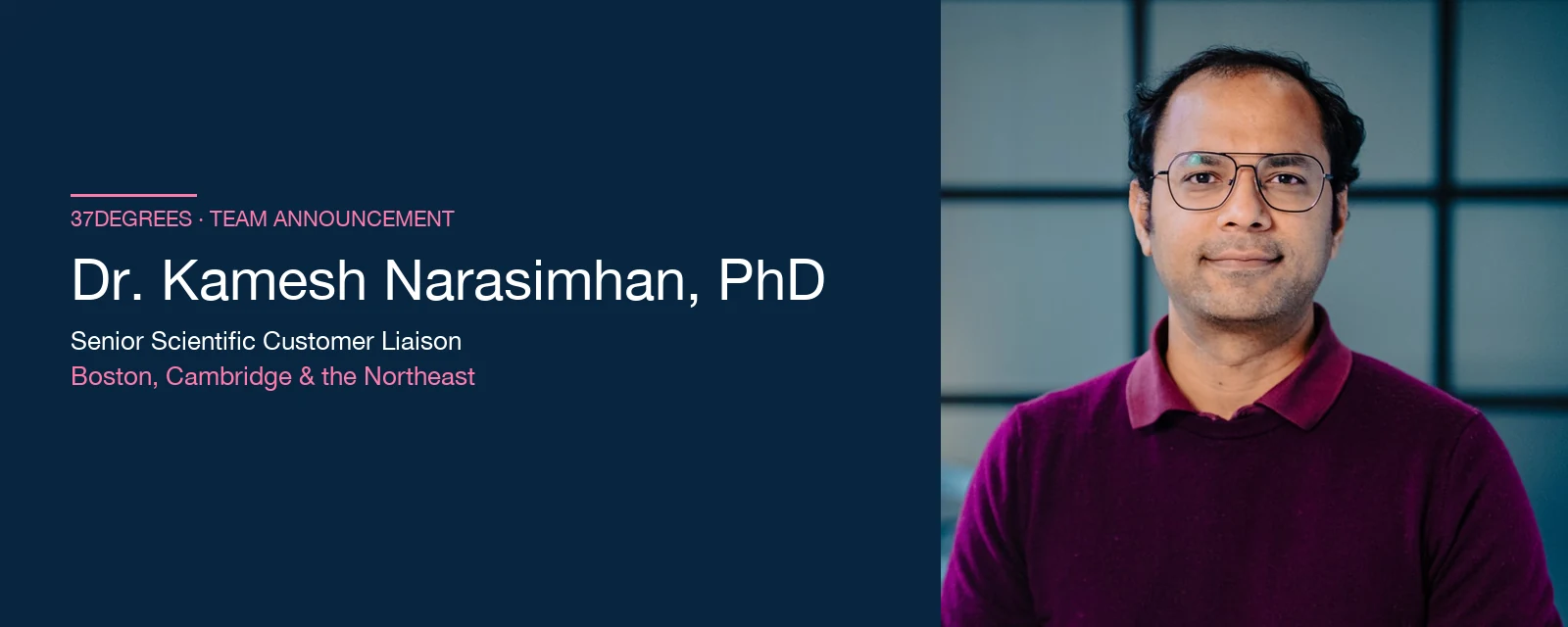
37degrees, Inc. is pleased to announce the appointment of Dr. Kamesh Narasimhan, PhD as Senior Scientific Customer Liaison covering the Boston / Cambridge ecosystem and the broader Northeast. Dr. Narasimhan is based in Boston / Cambridge, MA.
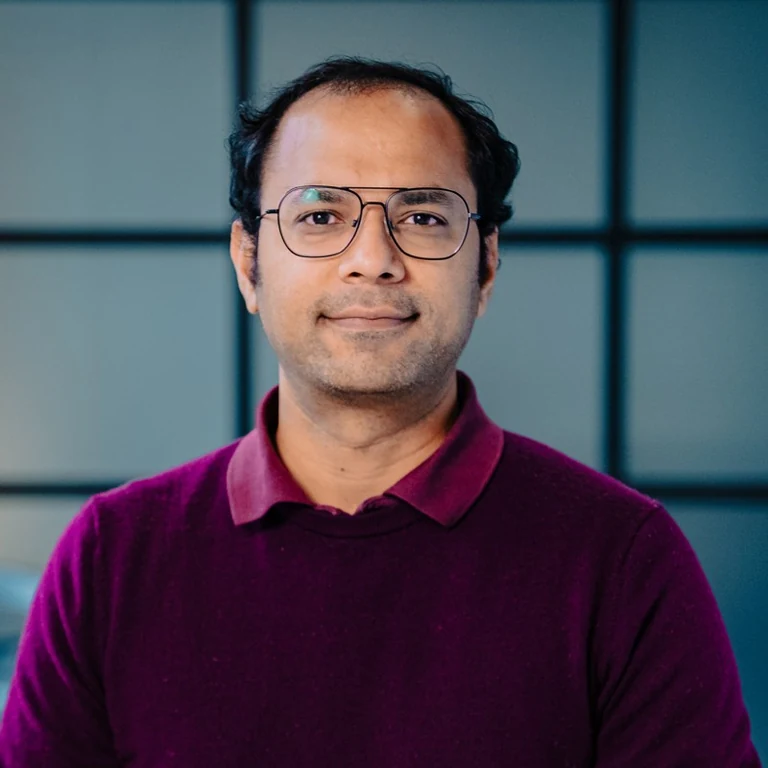
In this role, Dr. Narasimhan serves as the primary scientific point of contact for principal investigators, research scientists, and laboratory teams across the Boston / Cambridge corridor — including the Harvard Medical School Longwood campus, MIT, the Broad Institute, the Wyss Institute, LabCentral, and the broader Kendall Square biotech community — and the wider Northeast, who are evaluating or deploying 37degrees instruments and the OMĒOS data platform. The position is structured around scientific engagement — giving research groups direct access to a senior peer scientist as they integrate 37degrees technology into their experimental workflows.
Scientific background
Dr. Narasimhan is a synthetic biologist and protein engineer with more than a decade of research experience spanning academia, startup biotechnology, and selective consulting.
- B.Tech., Biotechnology — PSG College of Technology.
- M.S., Biotechnology — Indian Institute of Technology Madras.
- PhD, Biological Sciences — National University of Singapore.
- Postdoctoral training — Donnelly Centre for Cellular and Biomolecular Research, University of Toronto (2012–2015). Work focused on high-throughput regulatory genomics, including DNA-binding motif discovery and analysis for C. elegans transcription factors, bridging wet-lab and computational teams.
Dr. Narasimhan subsequently held senior research positions at the Church Lab and Wyss Institute, Harvard Medical School (2015–2022) — working on engineered translation systems, orthogonal ribosome:tRNA concepts, genetic code expansion, and microbial engineering, with analytical and sequencing workflows for tRNA aminoacylation, non-canonical amino acid incorporation, and D-amino acid detection — and at Pearl Bio (Cambridge, MA) as a Senior Scientist applying genetic code expansion and protein engineering to therapeutic protein workflows in a product-oriented startup. He was subsequently an Associate Research Scientist at the Beyond Center for Fundamental Concepts in Science, Arizona State University, conducting systems-level and computational research at the intersection of synthetic biology, astrobiology, and biochemical evolution.
In parallel, Dr. Narasimhan provides selective consulting to biotech clients on experimental and bioinformatics workflows — scoping ambiguous research questions into workplans, deliverables, and decision criteria.
Selected publications
Dr. Narasimhan’s research has been published in Nature, eLife, ACS Chemical Biology, Nucleic Acids Research, BMC Evolutionary Biology, and Molecular Cell, among others. The following are representative of the translation-engineering and regulatory-genomics work most directly relevant to 37degrees customers:
- Nyerges A, Vinke S, Flynn R, Owen SV, Rand EA, Budnik B, Keen E, Narasimhan K, et al. A swapped genetic code prevents viral infections and gene transfer. Nature. 2023. [PubMed →]
- Kuru E, Rittichier J, Wiegand D, Narasimhan K, et al. Release factor inhibiting antimicrobial peptides improve nonstandard amino acid incorporation in wild-type bacterial cells. ACS Chemical Biology. 2020. [PubMed →]
- Narasimhan K, Lambert SA, Yang AWH, et al. Mapping and analysis of Caenorhabditis elegans transcription factor sequence specificities. eLife. 2015. [PubMed →]
- Kamesh N, Aradhyam GK, Manoj N. The repertoire of G protein-coupled receptors in the sea squirt Ciona intestinalis. BMC Evolutionary Biology. 2008. [PubMed →]
The full publication record (19 peer-reviewed articles) is available on his Google Scholar profile.
Translational proposal work
Dr. Narasimhan has contributed to awarded academic and translational research proposals across DOE, NSF, NSF SBIR, and DoD STTR programs — including co-authorship on awarded NSF SBIR Phase I and DoD STTR funding applications during his tenure at Pearl Bio.
Areas of scientific expertise
Dr. Narasimhan’s technical depth spans the methodologies most directly relevant to modern cell-culture, protein, and translation-engineering workflows — and the kind of experimental questions 37degrees customers run every day:
- Cell and molecular biology workflows — cell-culture context, sample handoff reasoning, incubation and transport constraints, assay planning, and protocol / SOP-style documentation.
- Molecular biology and protein engineering — cloning, CRISPR / MAGE, in vitro transcription, protein expression and purification, genetic code expansion, and cell-free protein synthesis.
- Analytical methods — Agilent 6530 Q-TOF LC-MS, reverse-phase HPLC, chiral chromatography, AKTA / FPLC, and Ni-NTA protein purification.
- Sequencing and data workflows — NGS library preparation, tRNA-seq, MiSeq, and downstream analysis using Python, R, Benchling, GitHub, and Jupyter.
- Translational proposal writing — DOE, NSF, NSF SBIR, and DoD STTR contexts.
- Scientific communication and stakeholder alignment — discovery-style customer conversations, SOP / protocol writing, and slide-based scientific storytelling for technical and non-technical audiences.
Scientific support for Boston, Cambridge, and Northeast research groups
Dr. Narasimhan’s role is structured to give research groups in Boston, Cambridge, and across the broader Northeast a direct line to a senior scientist for the questions that matter when bringing connected instrumentation into a working laboratory.
That scope of support includes:
- Experimental-design consultation on the use of current 37degrees instruments — including CultureON 100 and the OMĒOS data platform — across a range of life-science and translational research contexts, with engagement on adjacent biological workflows as the 37degrees instrument platform expands.
- Workflow troubleshooting — sample handoffs, incubation and transport constraints, assay readouts, controls, and documentation practices for reproducible multi-day acquisitions.
- Technical interpretation of instrument output and OMĒOS-streamed datasets, including integration with downstream analysis pipelines.
- A scientific feedback channel back to the 37degrees engineering and research teams, so that what is learned in customer laboratories informs the next generation of 37degrees instruments — across both current and emerging biological application areas — and the open-source cellular image-analysis stack we maintain in collaboration with the broader community.
The Boston / Cambridge ecosystem is one of the densest concentrations of life-science research and biotechnology in the world — Harvard Medical School and its Longwood Medical Area institutions (including Beth Israel Deaconess, Brigham and Women’s, Boston Children’s, and Dana-Farber Cancer Institute); MIT, the Broad Institute, and the Whitehead Institute in Cambridge; the Wyss Institute for Biologically Inspired Engineering; the Kendall Square biotech corridor; LabCentral and the broader startup ecosystem; and Boston University, Northeastern University, and Tufts. The Northeast research corridor extends well beyond Boston — Yale School of Medicine in New Haven; Brown University in Providence; Cold Spring Harbor Laboratory on Long Island; the Rockefeller University, Memorial Sloan Kettering Cancer Center, Weill Cornell Medicine, Columbia, NYU, and Mount Sinai in New York City; Princeton in New Jersey; and the University of Pennsylvania and the Wistar Institute in Philadelphia. Dr. Narasimhan will be working directly with research groups across these and adjacent institutions.
Mentorship and scientific communication
Beyond his research, Dr. Narasimhan has mentored undergraduate, master’s, and PhD-level trainees at Harvard Medical School and the Wyss Institute, and worked with junior scientists at the Beyond Center on research framing, analysis workflows, and scientific communication. His professional posture — running discovery-style conversations to clarify scientific goals before proposing next steps, and translating technical results into accessible product language for mixed audiences — maps directly to the kind of peer-to-peer support 37degrees is structured to provide.
Contact
Research groups in Massachusetts, Connecticut, Rhode Island, New York, New Jersey, Pennsylvania, and the broader Northeast who would like to engage Dr. Narasimhan for a scientific conversation about cell-culture workflow design, protein engineering, translation systems, or the integration of 37degrees instrumentation into their workflows are encouraged to get in touch.
- Contact 37degrees → — messages route directly to our team and are triaged within one business day.
37degrees welcomes Dr. Narasimhan to the team and looks forward to the scientific partnerships this appointment will enable across Boston, Cambridge, and the broader Northeast research community.
About 37degrees
37degrees, Inc. designs portable, connected scientific instruments for life-science and biomedical research. The current instrument family addresses continuous live-cell culture and live-cell imaging, paired with the OMĒOS data platform; the broader product roadmap is an expanding instrument base spanning a wide range of biological workflows — from molecular and cellular research through translational and pre-clinical applications. The company is supported by the NSF SBIR program, the NVIDIA Inception Program, and AWS Activate.