37degrees, Inc. joins Portal Chicago at Fulton Labs, in the heart of Chicago's Fulton Market
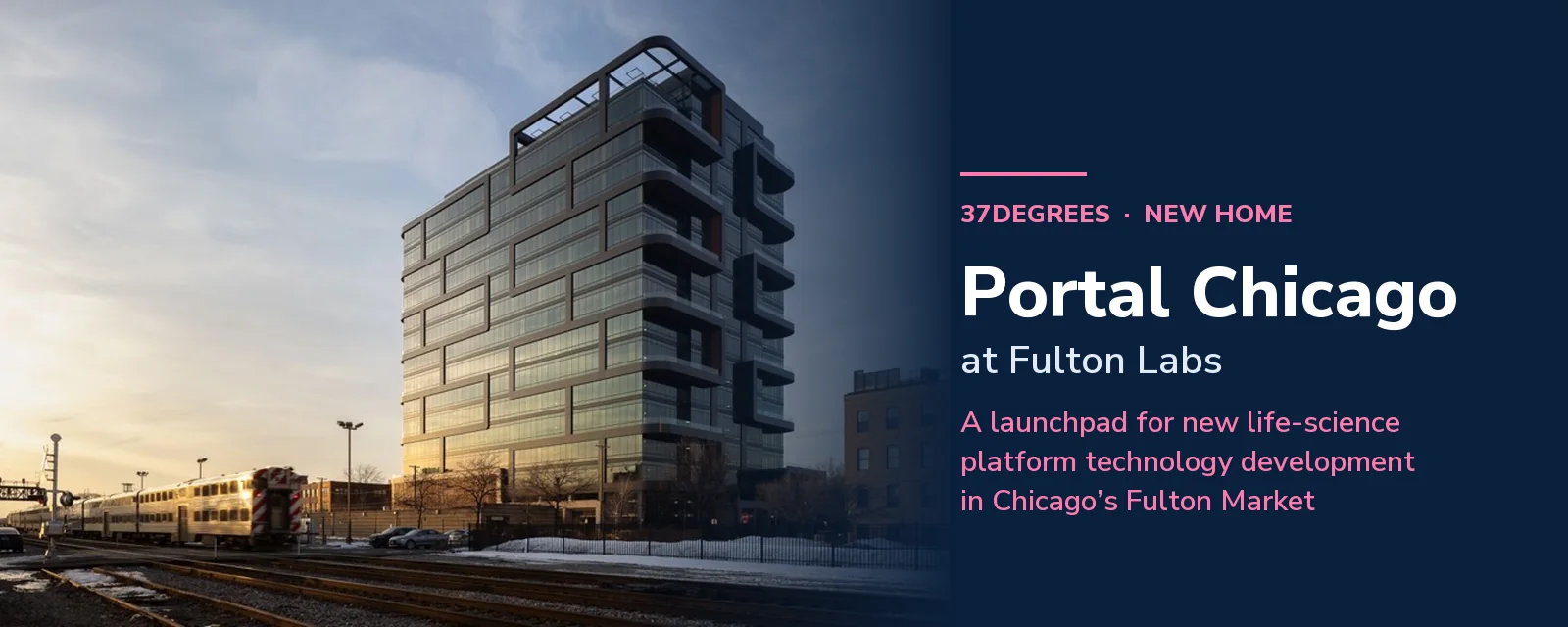
37degrees, Inc. has joined Portal Chicago, the flagship site of Portal Innovations, at Fulton Labs in Chicago’s Fulton Market district.
Portal Chicago is where our technology meets real science. It is our base for real-world life-science application development of our ON system modules, including CultureON 100 and FluidON 100, together with OMĒOS, our full-stack AI life-science software.
Why Portal
A technology is only as good as the science it makes possible. Proving that means putting it in the hands of working scientists, running it on real cells and real protocols, and learning where it fits into how a lab actually works.
Portal is built for exactly that. It is a community of life-science companies working side by side, with the infrastructure to do serious biology:
- Real wet-lab infrastructure. More than 100 lab benches, BSL-2 labs, tissue-culture hoods and chemical fume hoods, with more than $6 million of shared equipment [1].
- Room to grow. Individual benches, private lab suites, offices and conference rooms across more than 60,000 square feet [1]. We are starting with a home base for our team and will grow into Portal’s labs as our application work expands.
- A community that moves fast. More than 60 science and engineering companies work out of Portal’s Chicago site [1]. Many of them run exactly the kinds of cell-culture workflows our technology is designed for.
- A platform for acceleration. Portal is a venture development firm as well as a home for startups. It backs early-stage life-science companies with capital, mentors, programming and connections to investors and industry partners.
For us, that adds up to a short path from an idea to an answer. A new application can be discussed over coffee in the morning, tried on a colleague’s cultures that week, and turned into feedback for the next version of the product.
Inside Portal Chicago
Photographs courtesy of Portal Innovations.
From the bench to real-world applications
Our ON system modules are built to keep living cells in controlled conditions wherever the science needs them to be. CultureON 100 is a portable CO₂ incubator that holds temperature, CO₂ and humidity on battery power, with no gas line or wall socket. FluidON 100 is a perfusion module for 2D and 3D culture. OMĒOS, our full-stack AI life-science software, ties it all together. It collects data from the instruments automatically, organizes every experiment in an AI-native lab notebook, runs AI analysis in place, and lets scientists watch and control their experiments from anywhere.
At Portal, the question we are answering is not does it work? but what does it make possible? That means working alongside scientists on their own cell lines, organoids and tissue constructs, on the protocols they already run, and finding the applications where portable, connected culture changes what an experiment can be.
The same approach drives the two NIH-funded programs we announced this fall, both of which extend the ON system into new kinds of science:
- PamON adds photoacoustic microscopy to CultureON, so a living 3D tissue construct can be imaged in three dimensions, again and again, without being fixed, sectioned or taken out of the incubator. It is funded by an NIH STTR Phase I award.
- InVitreON grows living neurons, records their electrical activity and stimulates them with light, current or compounds, all in one closed, battery-powered system, for weeks at a time and at physioxic oxygen. It is funded by an NIH SBIR Phase I award.
Being at Portal puts both programs a short walk from the tissue engineers, neuroscientists and cell biologists they are being built for.
Portal will also be home to our National Science Foundation-funded work on ImageON, our long-term live-cell imaging solution. An NSF SBIR Phase I award funded the first stage of ImageON: making continuous, cloud-connected video microscopy of living cells affordable and accessible. At Portal we will develop it further, alongside the scientists who watch cells change over hours and days.
And as a member of the NVIDIA Inception Program, we are excited to bring GPU computing into biological workflows at Portal: high-performance computing for the large imaging and sensor datasets that live-cell experiments generate, and scientific AI model inference that runs right alongside the experiment.
Pilot CultureON and OMĒOS at Portal
We are partnering with Portal members and research groups across Chicago to pilot CultureON 100 and OMĒOS on their own science. If you work in or near Fulton Labs, we would like to hear from you: bring your cultures and your questions, and we will work through them together.

Now piloting at Portal Chicago
CultureON 100 + OMĒOS
- Holds 37 °C and CO₂ on battery for more than 8 hours, with no gas line or wall socket.
- About 5 lb. Carry live cultures between labs, cores and buildings.
- OMĒOS logs every reading and lets you watch and control the run from anywhere.
A pilot is a short, practical trial on your own work. Some examples:
- Moving live cells between your lab, a core facility and a collaborator across Fulton Market, the Illinois Medical District or Streeterville, without losing temperature or CO₂ on the way.
- Running a culture somewhere a standard incubator won’t go: next to a microscope, inside a hood or on an instrument bench.
- Watching an experiment from your phone through OMĒOS, with a full record of the conditions your cells actually saw.
What we learn from each pilot shapes the next version of the product, and the next application we take on.
Fulton Market: where Chicago’s life sciences are moving fast
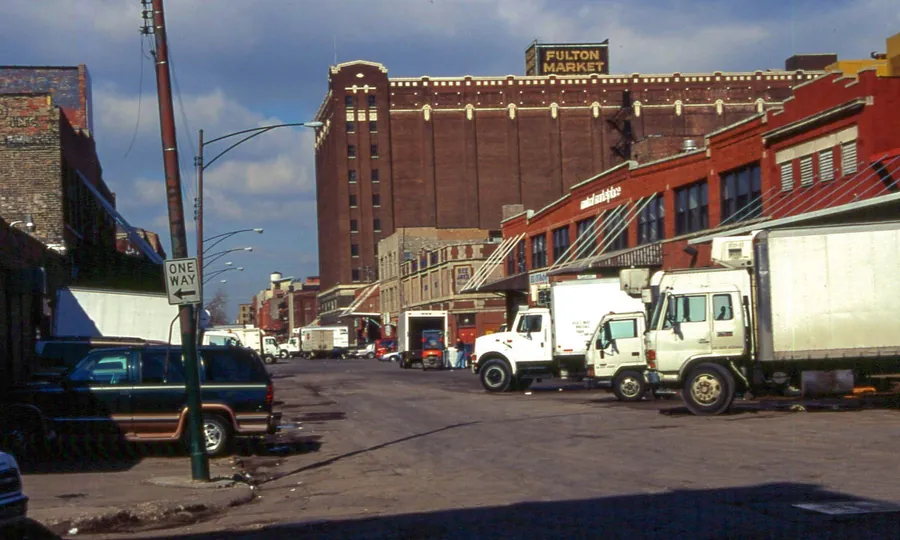
2002 · Loading docks and delivery trucks

2021 · Restaurants, offices and labs
Fulton Market, then and now. Photos: David Wilson (CC BY 2.0); ajay_suresh (CC BY 2.0). Resized.
A generation ago, Fulton Market was the city’s meatpacking and wholesale produce district. Today it is one of Chicago’s fastest-changing neighborhoods: McDonald’s moved its global headquarters here, tech companies followed, the old warehouses became restaurants and offices, and purpose-built lab buildings like Fulton Labs are going up alongside them.
Life science is a big part of that change. Portal opened its first Chicago lab in 2020, and its Fulton Labs site has since doubled in size [1]. Biohub Chicago, part of the nonprofit research institute founded by Priscilla Chan and Mark Zuckerberg, works out of the same building, building new tools to measure inflammation in human tissue [2], and Tempus AI is a few blocks away. Portal itself describes Chicago as having grown from barely on the map for scientific innovation to a top-10 U.S. market for it, with more than $2 billion of life-science venture funding since 2020 [1].
A neighborhood of research and industry
Few places put this much research, medicine and industry within easy reach. The University of Illinois Chicago and the Illinois Medical District are just south of us, Northwestern Medicine’s Streeterville campus is a short ride east, and two U.S. national laboratories are within an hour’s drive.
Chicagoland is also home to some of the largest life-science companies in the world. AbbVie and Abbott have their global headquarters in Lake County, Baxter is in Deerfield, Medline in Northfield and Fresenius Kabi USA in Lake Zurich, all within about 35 miles of Fulton Labs.
Fulton Labs
Fulton Labs
Fulton Market · In the building
Our new home. Portal Chicago and Biohub Chicago share the building, a few floors apart.
- Portal Chicago (37degrees)
- Biohub Chicago
Innovation hubs
mHUB
River West · 0.5 mi straight line
Chicago's hardware and physical-product innovation center: prototyping labs, machine shops and a hardtech accelerator.
Visit website →Life-science industry
Tempus AI
River North · 0.8 mi straight line
Chicago-born precision-medicine company applying AI to clinical and molecular data, headquartered a few blocks away.
Visit website →Innovation hubs
1871
Merchandise Mart · 1.0 mi straight line
Chicago's flagship startup hub, home to hundreds of early-stage tech companies and accelerators.
Visit website →Universities
University of Illinois Chicago
University Village · 1.3 mi straight line
A major public research university, with colleges of engineering and pharmacy and one of the largest medical schools in the US.
Visit website →Medical & clinical research
Illinois Medical District
Near West Side · 1.7 mi straight line
One of the largest urban medical districts in the US: hospitals, research institutes and the UIC health sciences campus in one square mile.
- UI Health & UIC College of Medicine
- Rush University Medical Center
- Jesse Brown VA Medical Center
- John H. Stroger Jr. Hospital of Cook County
Medical & clinical research
Northwestern Medicine, Streeterville
Streeterville · 1.8 mi straight line
Northwestern's medical school and research towers alongside two of the city's leading hospitals and a rehabilitation research hospital.
- Northwestern University Feinberg School of Medicine
- Northwestern Memorial Hospital
- Lurie Children's Hospital & Stanley Manne Children's Research Institute
- Shirley Ryan AbilityLab
Universities
Illinois Institute of Technology
Bronzeville · 4.0 mi straight line
A private technology university with strengths in biomedical and chemical engineering.
Visit website →Universities
University of Chicago
Hyde Park · 7.3 mi straight line
A leading research university and academic medical center, with Portal's UChicago Science Incubator at Hyde Park Labs nearby.
- University of Chicago & UChicago Medicine
- Polsky Center for Entrepreneurship and Innovation
- UChicago Science Incubator at Hyde Park Labs (Portal)
Medical & clinical research
Loyola University Chicago Health Sciences
Maywood · 9.5 mi straight line
Loyola's Stritch School of Medicine and Loyola University Medical Center, a short drive west.
Visit website →Universities
Northwestern University
Evanston · 12 mi straight line
Northwestern's main campus, home to the McCormick School of Engineering and its biomedical engineering research.
Visit website →Life-science industry
Medline
Northfield · 16 mi straight line
One of the largest manufacturers and distributors of medical supplies in the US.
Visit website →National laboratories
Argonne National Laboratory
Lemont · 20 mi straight line
A US Department of Energy national laboratory, home to the Advanced Photon Source and the Aurora supercomputer.
Visit website →Life-science industry
Baxter
Deerfield · 22 mi straight line
Global medical-products company, headquartered in Deerfield.
Visit website →Life-science industry
Fresenius Kabi USA
Lake Zurich · 30 mi straight line
North American headquarters of the global maker of injectable drugs, infusion therapies and biosimilars.
Visit website →Life-science industry
Abbott
Abbott Park · 31 mi straight line
Global healthcare company in diagnostics, medical devices and nutrition, headquartered in Lake County.
Visit website →National laboratories
Fermilab
Batavia · 31 mi straight line
America's particle physics and accelerator laboratory, run for the US Department of Energy.
Visit website →Life-science industry
AbbVie
North Chicago · 31 mi straight line
One of the world's largest biopharmaceutical companies, with its global headquarters and a major R&D campus north of the city.
Visit website →Tap or click any point on the map, or pick one from the list below.
That proximity is practical for us. CultureON was designed to move living cells between exactly these kinds of places: a culture grown in Fulton Market, imaged in a core in the Medical District, and handed to a collaborator in Streeterville the same afternoon.
And a beautiful city to do it in
Chicago is also simply a great place to build a company. Fulton Market is minutes from the Loop and its architecture, the Chicago Riverwalk, and the 18-mile Lakefront Trail along Lake Michigan. World-class museums, theater and music are a short ride away, there is great food on every corner, and two major airports put collaborators on either coast a short flight away.
Photo credits
- The skyline from North Avenue Beach at dusk. : Bohao Zhao , CC BY 3.0 , resized
- The Chicago Theatre on State Street. : ajay_suresh , CC BY 2.0 , resized
- The Chicago Picasso in Daley Plaza. : J. Crocker , Public domain
- The Art Institute of Chicago and its lions. : Ken Lund , CC BY-SA 2.0 , resized
- The Tiffany dome at the Chicago Cultural Center. : Amerique , CC BY 3.0 , resized
- The Wrigley Building, Tribune Tower and the Chicago River. : Matt Kieffer , CC BY-SA 2.0 , resized
- The Chicago Symphony Orchestra at Orchestra Hall. : Kroum , CC BY-SA 4.0 , resized
- The Lyric Opera at the Civic Opera House. : Jeffrey Beall , CC BY 4.0 , resized
- Buckingham Fountain in Grant Park. : An Errant Knight , CC BY-SA 4.0 , resized
- The Great Hall at Union Station. : Fyu , CC BY-SA 4.0 , resized
- Boats on the Chicago River. : piet theisohn , CC BY 2.0 , resized
- The Lakefront Trail at Oak Street Beach. : Chris Rycroft , CC BY 2.0 , resized
- The 'L' on the Loop. : Laurence's Pictures , CC BY 2.0 , resized
Above all, Chicago has deep roots in science, medicine and engineering, and a growing appetite for building companies from them. We are glad to be building ours here.
Work with us at Portal
If you’re a Portal member, a researcher nearby, or anyone who would like to see our technology in person, come and find us.
- Book a CultureON + OMĒOS pilot →: messages route directly to our team and are triaged within one business day.
- CultureON 100 →: the portable CO₂ incubator at the center of the ON system.
- OMĒOS →: our full-stack AI life-science software, from automatic data capture and an AI-native lab notebook to AI analysis and remote control of experiments.
- Portal Chicago →: lab and office space, membership and tours.
References
- Portal Innovations. Portal Chicago at Fulton Labs. [portalinnovations.com →]
- Biohub. CZI, State and City Leaders Launch Chan Zuckerberg Biohub Chicago. [biohub.org →]
Photographs of Portal Chicago and the drone video courtesy of Portal Innovations. Photographs of Chicago from Wikimedia Commons, credited individually under each gallery.
About Portal Innovations
Portal Innovations is a venture development firm that helps early-stage life-science and engineering companies grow, with lab and office space, shared equipment, capital and a community of founders. Portal was founded in Chicago in 2020 and also runs the UChicago Science Incubator at Hyde Park Labs, with further sites in Providence, New Jersey and Salt Lake City. portalinnovations.com →
About 37degrees
37degrees, Inc. designs portable, connected scientific instruments for life-science and biomedical research. The current instrument family addresses continuous live-cell culture and live-cell imaging, paired with the OMĒOS data platform; the broader product roadmap is an expanding instrument base spanning molecular and cellular research through translational and pre-clinical applications. The company is supported by the National Institutes of Health, the NSF SBIR program, the NVIDIA Inception Program, and AWS Activate.
Frequently asked questions
- Where is 37degrees located in Chicago?
- At Portal Chicago, Portal Innovations' life-science lab and office space at Fulton Labs, 400 N Aberdeen St, in Chicago's Fulton Market district.
- What is Portal Innovations?
- Portal Innovations is a venture development firm that gives early-stage life-science and engineering companies lab and office space, shared equipment, capital and a community. Portal was founded in Chicago in 2020, and its Fulton Labs site now holds more than 60 companies, more than 100 lab benches and over $6 million of shared equipment.
- What will 37degrees do at Portal?
- Portal Chicago is our base for real-world life-science application development: taking our ON system modules, such as CultureON 100 and FluidON 100, and the OMĒOS software into the workflows of working scientists, and running pilots with Portal members and Chicago research groups. It will also be home to our NSF-funded development of ImageON, our long-term live-cell imaging solution, and to GPU-accelerated computing and scientific AI in biological workflows as an NVIDIA Inception member, and it puts our NIH-funded PamON and InVitreON programs close to the scientists they are being built for.
- Can I pilot CultureON 100 or OMĒOS at Portal?
- Yes. We are partnering with Portal members and research groups across Chicago to pilot CultureON 100 and OMĒOS on their own work. Get in touch through our contact page to set one up.
- What research institutions and life-science companies are near Fulton Labs?
- Biohub Chicago is in the same building, and Tempus AI is a few blocks away. Within about two miles are the University of Illinois Chicago, the Illinois Medical District (including Rush University Medical Center and UI Health) and Northwestern Medicine's Streeterville campus. Further out are the University of Chicago, Illinois Tech, Northwestern's Evanston campus, Argonne National Laboratory and Fermilab, along with the headquarters of AbbVie, Abbott, Baxter, Medline and Fresenius Kabi USA.